
Civil Engineering

Accredited by the National Board of Accreditation (NBA) under Tier-I

Infrastructure

Academic spaces supporting effective teaching, experimentation, and innovation

The Department of Electrical and Electronics Engineering is supported by well-planned infrastructure that enhances the teaching–learning process. Modern classrooms, well-equipped laboratories, and centres of excellence provide students with an engaging and practical learning environment.

Classrooms

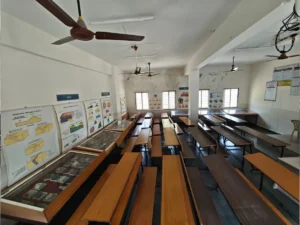
The department has spacious, well-ventilated classrooms equipped with modern teaching aids to support effective classroom instruction.

Laboratories

The Department of Electrical and Electronics Engineering houses well-equipped laboratories that support hands-on learning, experimentation, simulation, and project development across core and emerging areas of the discipline.

The Basic Electrical Engineering Laboratories provide foundational practical training for first-year students. These labs introduce basic electrical laws, circuit elements, and safety practices through simple yet essential experiments.

Major Equipment Available
  • RLC circuit trainer kits
  • DC and AC power supply units
  • Rheostats and load banks
  • Basic measuring instruments
  • Wiring boards and safety accessories


The Control Systems Laboratory focuses on the analysis and design of control systems using both hardware and software platforms. Students gain experience in time-domain and frequency-domain analysis, stability assessment, and controller design for dynamic systems.

Major Equipment Available
  • DC and AC servo motor control units
  • PID controller trainers
  • Synchro transmitter–receiver systems
  • Control system trainer kits
  • Frequency response analysis modules
  • MATLAB/Simulink

The Electrical Machines Laboratory provides extensive hands-on exposure to the construction, operation, and performance analysis of electrical machines. Students study DC machines, transformers, and AC machines through experiments focused on characteristics, efficiency, losses, speed control, and testing procedures. The laboratory strengthens understanding of machine behavior under various operating conditions.

Major Equipment Available
  • DC shunt, series, and compound motors
  • DC generators
  • Single-phase and three-phase transformers
  • Three-phase induction motors (squirrel cage and slip ring)
  • Synchronous motors and alternators
  • Motor loading and starter panels
  • Digital tachometers and power measurement units

The Electrical Measurements and Instrumentation Laboratory introduces students to measurement techniques and instrumentation used for accurate monitoring of electrical parameters. Emphasis is placed on precision, calibration, and correct usage of measuring instruments.

Major Equipment Available
  • Analog and digital voltmeters and ammeters
  • Wattmeters and energy meters
  • LCR meters
  • CRO and Digital Storage Oscilloscopes
  • Instrument transformers (CTs and PTs)
  • Transducers and signal conditioning units


The Power Electronics Laboratory provides hands-on experience with power semiconductor devices and converter circuits used in industrial and power applications. Students study conversion of electrical power using controlled and uncontrolled rectifiers, inverters, and choppers.

Major Equipment Available
  • Single-phase and three-phase converter trainers
  • Chopper and inverter trainer kits
  • SCR, MOSFET, and IGBT modules
  • Gate triggering and firing circuits
  • Oscilloscopes and power analyzers


This laboratory emphasizes the study of electric motor drives using power semiconductor devices. Students perform experiments on speed control, torque characteristics, and dynamic performance of DC and AC drives.

Major Equipment Available
  • DC motor drive trainer kits
  • AC motor drive setups
  • Thyristor-controlled drive units
  • PWM inverter-based drive modules
  • Motor loading and braking arrangements


The Power Systems Laboratory enables students to understand the fundamentals of electrical power generation, transmission, distribution, and protection. Practical experiments help students analyze system performance, fault conditions, and power quality aspects in real-world power networks.

Major Equipment Available
  • Transmission line models
  • Alternator and load-sharing panels
  • Overcurrent and earth fault relays
  • Distance and differential protection relays
  • Circuit breakers and protection devices
  • High-voltage testing kits

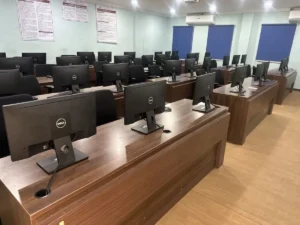
The Simulation Laboratories support modeling, analysis, and visualization of electrical and power systems. Students learn to simulate complex systems and study system behavior before real-time implementation.

Major Software & Facilities Available
  • MATLAB and Simulink
  • MiPower software
  • PSCAD / ETAP (as applicable)
  • Dedicated simulation workstations
  • Power system and control modeling tools
  • Control and power electronics simulation tools

Project Laboratory

The Project Laboratory is a dedicated space that enables students to apply theoretical knowledge through practical implementation. It supports undergraduate and postgraduate students in executing mini and major projects in areas such as power electronics, embedded systems, renewable energy, smart systems, and automation.

The laboratory promotes innovation, teamwork, and interdisciplinary collaboration. Faculty members and technical staff actively guide students in the use of equipment and tools, making this lab a hub for creativity, applied learning, and industry-oriented development.

Objectives

Major Facilities and Equipment

Research Laboratory

The Research Laboratory provides an advanced environment for students and faculty to explore, experiment, and innovate using modern simulation tools and development platforms. The laboratory supports research and project work in embedded systems, power systems, control systems, automation, and IoT applications.

The lab integrates software-based modeling with hardware implementation, enabling students to convert theoretical concepts into working models and research prototypes.

Objectives

Major Facilities and Tools

Centre of Excellence – CREST

CREST – Centre for Renewable Energy and Sustainable Technologies

The Centre of Excellence – CREST is a multidisciplinary research, training, and innovation hub focused on renewable energy and sustainable technologies. Supported by WindStream Energy Technologies, CREST provides students and faculty with industry exposure, technical expertise, and advanced infrastructure.

The centre enables hands-on learning and applied research in solar, wind, energy storage, and power quality, addressing real-world challenges related to sustainable energy systems and grid integration.

Focus Areas

Facilities and Equipment